
Doxycycline Monohydrate: Uses, Dosage, Side Effects & How It Differs from Hyclate

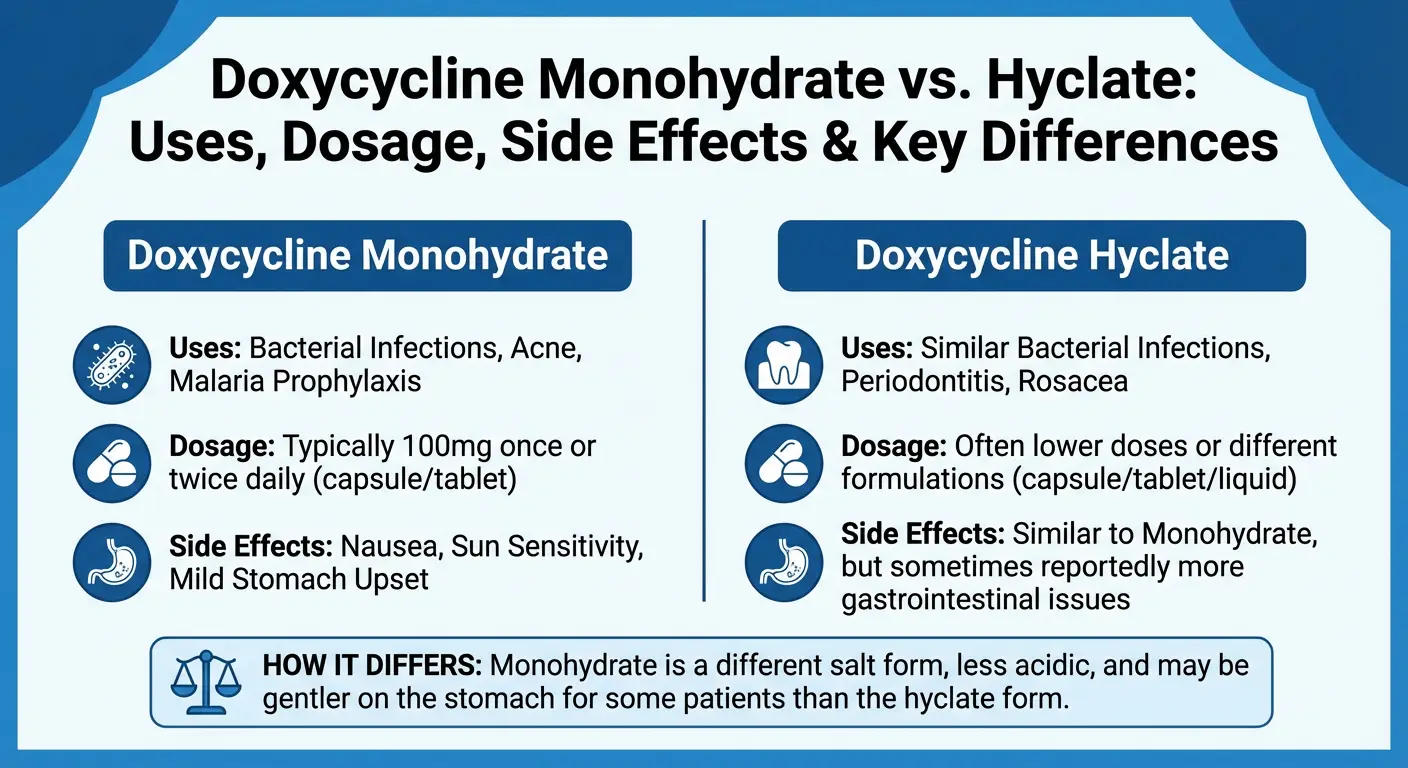
Doxycycline monohydrate is a salt form of doxycycline — a broad-spectrum tetracycline antibiotic used to treat bacterial infections including acne, chlamydia, Lyme disease, and respiratory infections. It is slightly less water-soluble than doxycycline hyclate, which often makes it gentler on the stomach and better tolerated by patients with gastrointestinal sensitivity.
What Is Doxycycline Monohydrate?
Doxycycline monohydrate is one of two primary oral salt forms of doxycycline — the other being doxycycline hyclate. Both forms contain the same active antibiotic compound and work through the same mechanism of action, but they differ in their chemical structure, solubility, and in some cases, tolerability.
The “monohydrate” in its name refers to the fact that one molecule of water is incorporated into the drug’s crystal structure. This makes doxycycline monohydrate slightly less water-soluble than doxycycline hyclate — and that difference, while seemingly minor, has a meaningful clinical benefit. Because it dissolves more slowly, it tends to produce a lower level of acidity in the esophagus and stomach during dissolution, which is why many patients — particularly those with a sensitive stomach — find doxycycline monohydrate easier to tolerate than the hyclate form.
Like all forms of doxycycline, doxycycline monohydrate is a prescription-only antibiotic. It belongs to the tetracycline class of antibiotics and works by inhibiting bacterial protein synthesis, effectively stopping bacteria from growing and multiplying. It is sold under brand names including Monodox® and is also widely available as a generic.
Doxycycline Monohydrate vs Doxycycline Hyclate: What Is the Difference?
One of the most common questions patients ask is whether doxycycline monohydrate and doxycycline hyclate are the same thing. The answer is: they contain the same active antibiotic, but they are not identical.
Both forms are equally effective at treating bacterial infections — clinical studies have not shown any meaningful difference in therapeutic outcomes between the two. The key differences come down to chemistry, tolerability, and cost.
Doxycycline hyclate is water-soluble and slightly more acidic when dissolved, which can sometimes irritate the esophagus or stomach lining. Doxycycline monohydrate dissolves more slowly and produces less acidity, making it the preferred choice for patients who experience nausea, stomach upset, or esophageal irritation with the hyclate form. However, doxycycline hyclate tends to be more widely available and is often less expensive, which is why it remains the more commonly prescribed form in many clinical settings.
In practical terms, if your doctor prescribes doxycycline, the form you receive may depend on availability, cost, and your personal history with gastrointestinal side effects. Always confirm with your pharmacist before substituting one form for the other.
What Is Doxycycline Monohydrate Used For?
Doxycycline monohydrate shares the same broad therapeutic indications as other forms of doxycycline. It is used to treat and prevent a wide range of bacterial infections across multiple body systems.
Bacterial Infections
Doxycycline monohydrate is effective against both gram-positive and gram-negative bacteria, making it one of the most versatile antibiotics in clinical practice. It is commonly prescribed for urinary tract infections (UTIs), respiratory tract infections including community-acquired pneumonia and bronchitis, skin and soft tissue infections, eye infections, and gum disease (periodontal disease).
Sexually Transmitted Infections
Doxycycline monohydrate is a first-line or alternative treatment for several sexually transmitted infections including chlamydia, gonorrhea, syphilis, pelvic inflammatory disease, lymphogranuloma venereum, and nongonococcal urethritis. It is one of the most reliable oral antibiotics for treating chlamydia and is included in CDC guidelines as a recommended treatment option.
Acne and Rosacea
For many patients, doxycycline monohydrate is the preferred form for long-term acne treatment precisely because of its better stomach tolerability. It works by killing the bacteria that infect pores and by reducing inflammation — both of which are key drivers of acne breakouts. For rosacea, low-dose doxycycline monohydrate works primarily through its anti-inflammatory mechanism to reduce facial redness, pimples, and bumps without functioning as a full antibiotic at that dose.
Lyme Disease
Doxycycline monohydrate is the first-line oral treatment for Lyme disease, particularly for the early stage presenting with erythema migrans (the characteristic bull’s-eye rash). It is also recommended for chemoprophylaxis following a high-risk Ixodes tick bite when given within 72 hours of tick removal, per IDSA, American Academy of Neurology, and American College of Rheumatology guidelines.
Malaria Prevention
Doxycycline monohydrate is a widely recommended option for malaria prophylaxis in travelers heading to regions where chloroquine-resistant Plasmodium falciparum is prevalent. It is taken once daily starting 1 to 2 days before entering a malaria-endemic area, continued throughout the trip, and for 4 weeks after returning.
Tick-Borne and Rickettsial Infections
Doxycycline monohydrate is the treatment of choice for Rocky Mountain spotted fever, Q fever, typhus, and other tick-borne rickettsial infections. Prompt treatment is critical in these conditions as delays can lead to serious complications.
Respiratory Infections
For Mycoplasma pneumoniae infections, doxycycline monohydrate is considered a first-line treatment. It is also an alternative agent for Chlamydophila pneumoniae respiratory infections and serves as an alternative to macrolides in community-acquired pneumonia for outpatients who cannot tolerate or are contraindicated for macrolides or fluoroquinolones.
Anthrax
Doxycycline monohydrate is a first-line agent for postexposure prophylaxis and treatment of inhalational anthrax and uncomplicated cutaneous anthrax, per CDC guidelines.
Other Infections
Additional indications include cholera, tularemia, plague, brucellosis, bartonellosis, actinomycosis, and various other bacterial infections caused by susceptible organisms including Mycoplasma, Rickettsia, Chlamydia, and Borrelia species.
How Doxycycline Monohydrate Works
Doxycycline monohydrate works through the same mechanism as all tetracycline antibiotics. It exerts a bacteriostatic effect — inhibiting bacterial growth rather than directly killing bacteria, though bacterial death follows as the bacteria can no longer reproduce or maintain essential functions.
The drug enters bacterial cells by passing through outer membrane porin channels in gram-negative bacteria and across the cytoplasmic membrane in gram-positive bacteria via an energy-dependent process. Once inside, it binds to the 30S ribosomal subunit — the component of bacterial machinery responsible for assembling proteins. By binding here, doxycycline prevents aminoacyl-tRNA from attaching to the ribosomal A site, blocking the elongation phase of protein synthesis and halting production of the proteins bacteria need to survive.
Beyond its antibiotic action, doxycycline monohydrate also has anti-inflammatory and immunomodulatory properties. It inhibits leukocyte migration during inflammation, suppresses nitric oxide synthase activity, and inhibits matrix metalloproteinases — enzymes involved in tissue breakdown during chronic inflammatory conditions. These properties underpin its effectiveness in treating acne, rosacea, periodontal disease, and off-label use in conditions like rheumatoid arthritis.
Doxycycline also exhibits a postantibiotic effect, meaning bacterial growth suppression continues even after drug concentrations in the blood fall below the minimum inhibitory concentration. This contributes to its durable clinical effectiveness.
Dosage and Administration
Standard Adult Dosage
For most bacterial infections, the standard adult dose of doxycycline monohydrate is 100 mg twice daily on the first day (loading dose), followed by 100 mg once daily or 50 mg twice daily for the remainder of the course. The total duration depends on the specific infection being treated.
For acne, lower doses of 50 mg to 100 mg once or twice daily may be used for longer periods, always under medical supervision. For rosacea, a subantimicrobial dose of 40 mg daily (using specific formulations) is used to leverage anti-inflammatory effects without activating the antibiotic mechanism.
For malaria prophylaxis, 100 mg once daily is taken starting 1 to 2 days before travel, continued throughout the trip, and for 4 weeks after returning — but not for longer than 4 months total.
For anthrax postexposure prophylaxis, 100 mg twice daily for 60 days is the recommended course.
How to Take Doxycycline Monohydrate
Doxycycline monohydrate can be taken with or without food. Taking it with food or milk can help reduce stomach upset — a key advantage of the monohydrate form over hyclate. Always take it with a full glass of water (at least 8 ounces) and remain upright for at least 30 minutes after taking to prevent esophageal irritation and ulceration.
Take it at the same time each day to maintain consistent blood levels. Space doses of antacids, iron supplements, calcium supplements, and multivitamins at least 2 hours away from your doxycycline dose, as these significantly reduce absorption through chelation.
Never crush, split, or chew delayed-release formulations. Swallow capsules and tablets whole unless specifically instructed otherwise.
Pediatric Dosage
Doxycycline monohydrate is contraindicated in children under 8 years of age for most indications due to the risk of permanent tooth discoloration and suppression of bone growth. Exceptions exist for life-threatening conditions such as anthrax and Rocky Mountain spotted fever when no safer alternatives are available.
For children 8 years and older weighing less than 45 kg, the dose is weight-based — typically 4.4 mg/kg/day divided into two doses on the first day, followed by 2.2 mg/kg/day. For children weighing 45 kg or more, standard adult dosing applies.
Side Effects of Doxycycline Monohydrate
Common Side Effects
The most frequently reported side effects of doxycycline monohydrate include nausea, vomiting, stomach upset, diarrhea, loss of appetite, skin rash or itching, headache, and photosensitivity. Because the monohydrate form is less acidic than hyclate, it tends to cause less gastrointestinal irritation — but these side effects can still occur, particularly at higher doses.
Photosensitivity is one of the most consistently reported side effects. Doxycycline can cause exaggerated sunburn reactions even with brief exposure to sunlight. Patients should apply SPF 30+ sunscreen daily, wear protective clothing, avoid direct sunlight between 10 AM and 3 PM, and completely avoid tanning beds during treatment.
Serious Side Effects
Serious side effects are rare but require immediate medical attention. These include severe allergic reactions (anaphylaxis) with symptoms such as throat swelling, hives, and difficulty breathing; Stevens-Johnson syndrome and toxic epidermal necrolysis — rare but potentially life-threatening skin reactions; intracranial hypertension presenting with severe headache, blurred or double vision, and visual disturbances; esophageal ulceration if tablets or capsules lodge in the esophagus; and Clostridioides difficile-associated diarrhea (CDAD), which can range from mild diarrhea to life-threatening colitis.
Long-term use carries additional risks including tooth discoloration in young children, fungal superinfections, and — particularly with high-dose or prolonged use — liver toxicity requiring monitoring of liver function tests.
Drug Interactions
Doxycycline monohydrate shares the same drug interaction profile as other doxycycline formulations. The most clinically significant interactions include:
Antacids, calcium supplements, iron supplements, and magnesium-containing laxatives all significantly reduce doxycycline absorption through chelation of divalent and trivalent cations. These products should be taken at least 2 hours before or 3 hours after doxycycline.
Warfarin and other anticoagulants — doxycycline can enhance the anticoagulant effect of warfarin through competitive albumin binding and inhibition of the cytochrome P-450 pathway. Patients on blood thinners need careful monitoring when starting or stopping doxycycline.
Isotretinoin — the combination of doxycycline monohydrate and isotretinoin significantly raises the risk of pseudotumor cerebri (idiopathic intracranial hypertension). This combination must be avoided. A washout period of approximately 7 days is recommended between the two medications.
Anticonvulsants including barbiturates, carbamazepine, and phenytoin can decrease the serum half-life of doxycycline, reducing its effectiveness.
Oral contraceptives — doxycycline may reduce the effectiveness of hormonal birth control. A backup non-hormonal contraceptive method should be used throughout treatment.
Penicillin antibiotics — concurrent use is generally not recommended as doxycycline’s bacteriostatic action can interfere with penicillin’s bactericidal mechanism.
Who Should Not Take Doxycycline Monohydrate?
Doxycycline monohydrate is absolutely contraindicated in individuals with a known allergy to doxycycline or any other tetracycline antibiotic including minocycline, tetracycline, or demeclocycline.
It is relatively contraindicated in patients with liver disease due to rare but documented hepatotoxicity, in pregnant women due to teratogenicity and risk of permanent tooth discoloration in the unborn baby, in breastfeeding mothers where prolonged use is concerned, in children under 8 years for routine infections, in patients with a history of intracranial hypertension, in patients with active lupus, and in those with myasthenia gravis.
Special Populations
Pregnancy
Doxycycline monohydrate is generally not recommended during pregnancy. It crosses the placenta and can cause retardation of skeletal development and permanent tooth discoloration in the unborn baby, particularly if taken in the second half of pregnancy. Embryotoxicity has also been observed in animal studies. Always notify your doctor immediately if you become pregnant while taking doxycycline.
Breastfeeding
Short-term use of doxycycline monohydrate during breastfeeding is considered by some guidelines to carry minimal risk due to low drug concentrations in breast milk and reduced infant absorption through calcium binding. However, prolonged or repeated courses should be avoided due to theoretical risks of dental discoloration and effects on bone growth and gastrointestinal flora in the nursing infant.
Elderly Patients
No specific dose adjustments are required for older adults. However, medication reconciliation is important due to the increased risk of polypharmacy in this population, and clinicians should review all concurrent medications for potential interactions before prescribing.
Renal Impairment
Unlike many other antibiotics, doxycycline monohydrate does not require dose adjustment in patients with renal impairment. Its serum half-life of 18 to 22 hours remains consistent regardless of kidney function, and hemodialysis does not significantly alter its elimination.
Monitoring and Safety
For short courses of doxycycline monohydrate, no specific routine monitoring tests are required. For long-term use — such as in chronic acne treatment or malaria prevention — the following monitoring is recommended: liver function tests (LFTs) to detect hepatotoxicity, assessment for photosensitivity, monitoring for signs of fungal superinfection, and regular assessment of treatment effectiveness.
Patients taking doxycycline monohydrate long-term for acne should have periodic follow-up with their prescribing clinician to reassess the need for continued therapy and to minimize the risk of contributing to antibiotic resistance.
FAQs
Is doxycycline monohydrate the same as doxycycline?
Yes and no. Doxycycline monohydrate contains the same active antibiotic as all forms of doxycycline and works the same way. The “monohydrate” refers to the specific salt form, which affects its water solubility and stomach tolerability. It is equally effective therapeutically but is generally considered gentler on the digestive system than doxycycline hyclate.
Which is better — doxycycline monohydrate or hyclate?
Neither is clinically superior in terms of antibiotic effectiveness. The main difference is tolerability. Doxycycline monohydrate tends to cause less stomach upset and esophageal irritation. If you have experienced gastrointestinal side effects with doxycycline hyclate, asking your doctor about doxycycline monohydrate may be worthwhile. Hyclate is often more widely available and less expensive.
Can doxycycline monohydrate be taken with food?
Yes. Unlike some forms of doxycycline that must be taken on an empty stomach, doxycycline monohydrate can generally be taken with food or milk to help reduce stomach upset. Always take it with a full glass of water and stay upright for at least 30 minutes afterward to prevent esophageal irritation.
How long does it take for doxycycline monohydrate to work?
For bacterial infections, most patients notice improvement within 2 to 3 days of starting treatment. For acne and rosacea, it typically takes 4 to 6 weeks to see meaningful improvement. Always complete the full prescribed course even if you feel better earlier — stopping too soon increases the risk of treatment failure and antibiotic resistance.
Can I take doxycycline monohydrate if I am allergic to penicillin?
Yes, in most cases. Doxycycline monohydrate belongs to the tetracycline class of antibiotics and is completely unrelated to penicillin. It is often specifically prescribed as an alternative for patients who are allergic to penicillin. Always inform your doctor of all your allergies before starting any new medication.
What brand name is doxycycline monohydrate sold under?
The most well-known brand name for doxycycline monohydrate is Monodox®. It is also widely available as a generic under the name doxycycline monohydrate.
Final Thoughts
Doxycycline monohydrate is a clinically proven, broadly effective tetracycline antibiotic that has earned a firm place in modern medicine. Its slightly lower water solubility compared to doxycycline hyclate translates into a real-world benefit for patients who struggle with gastrointestinal side effects — making it the preferred choice for those requiring longer courses of therapy, such as acne treatment or malaria prophylaxis.
Whether you have been prescribed it for a short-term infection or a longer-term condition, the principles of responsible use remain the same: take it exactly as prescribed, complete the full course, be mindful of the key drug interactions and sun sensitivity precautions, and never take it without a valid medical reason. Doxycycline monohydrate is a powerful tool — and like all powerful tools, it works best when used correctly and responsibly.
If you have questions about whether doxycycline monohydrate is the right choice for your condition, speak with your doctor or pharmacist. And if you experience any unusual or severe side effects, seek medical attention promptly.
Medical Disclaimer: This article is for informational purposes only and does not constitute medical advice, diagnosis, or treatment. Always consult a licensed healthcare professional before starting or changing any medication. Visit https://doxycycline.blog/ for more information.